
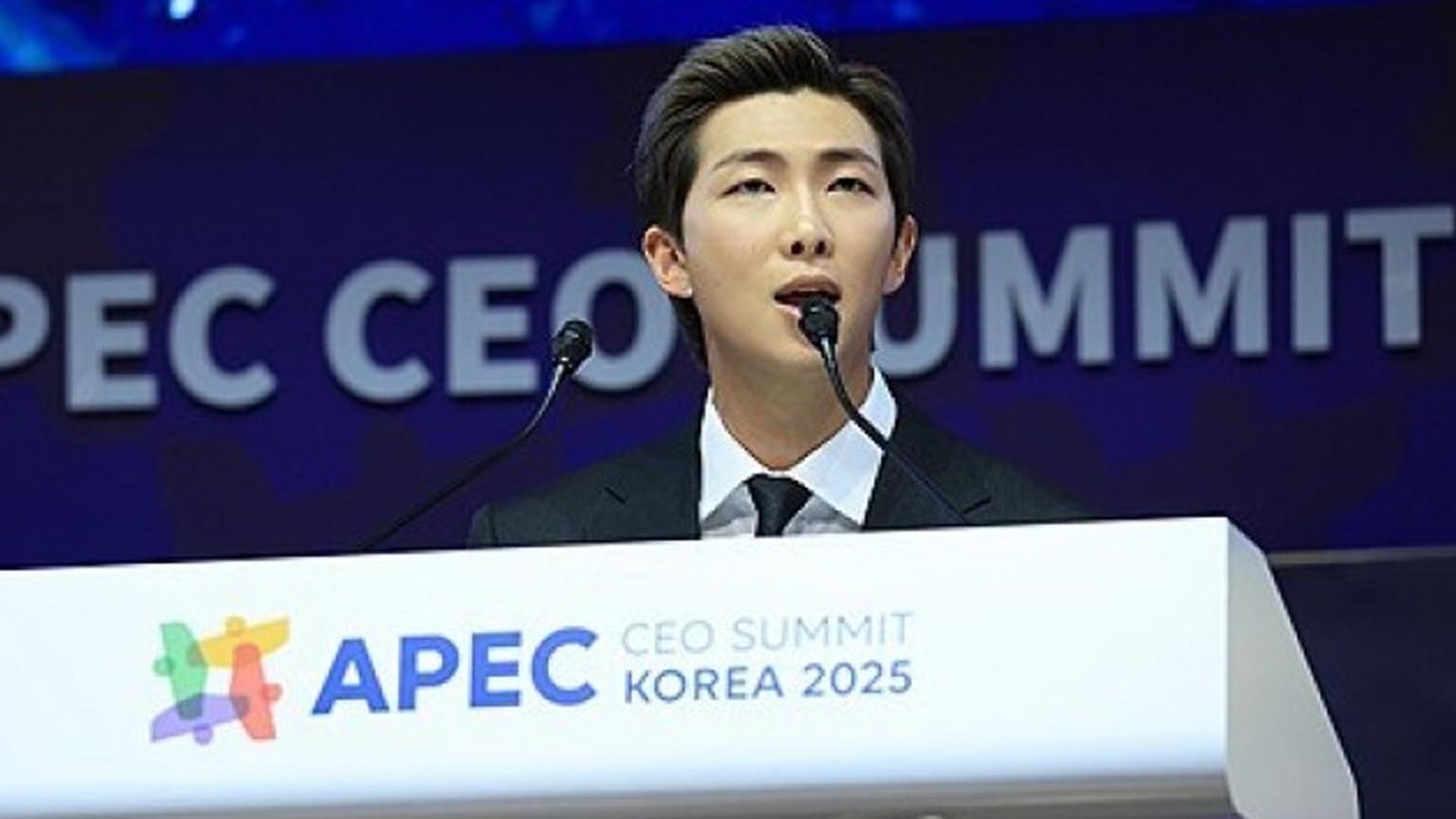







BTS frontman RM on Wednesday became the first K-pop artist to deliver a keynote address at the Asia-Pacific Economic Cooperation (APEC) CEO Summit, likening the genre’s global appeal to “bibimbap,” the Korean mixed rice dish that blends diverse ingredients into one harmonious whole.
Speaking at the Gyeongju Arts Center in the southeastern city of Gyeongju on “the cultural and creative industries in the APEC region and the soft power of Korean culture,” the 31-year-old said K-pop’s power lies in its ability to cross borders and connect people through shared emotions.
“I’d like to compare K-pop music to bibimbap,” RM said. “You take rice, add vegetables, meat and flavorings, and mix it all up — that’s the key part. K-pop is much the same. It takes Korea’s unique aesthetics and emotions but doesn’t turn away elements of Western music like hip-hop, R&B or EDM. These parts all keep their identities, but when mixed together, they create something new, fresh and delightful.”
He described K-pop as “a 360-degree total package of music, dance, performance, storytelling, visuals and even social media,” adding that its success “didn’t happen because one single culture was better, but because it respected diversity and embraced others while holding onto a Korean identity.”
RM recalled BTS’s early struggles a decade ago, when trying to get a mainstream media for foreign music in the English-speaking world was seen as an “experiment.”
“We tried to get on TV to show the world our music, but the doors were closed,” he said. “When we said we were artists from Korea, people asked, ‘Are you from North or South Korea?’ or even, ‘Where on earth is Korea?’”
He credited the group’s fanbase, known as ARMY, for breaking those barriers.
“The force that broke down the walls was ARMY,” he said. “They used our music as a medium for conversations that cross borders. They gave me a voice that was heard at the Billboard Music Awards, the Grammys, the United Nations, the White House — and now, here at APEC.”
RM called the fandom “a new community shaped by the pure power of cultural solidarity and tolerance,” saying it continues to inspire him.
“Culture is like a river,” he added. “It flows freely, sometimes coming together in harmony to create something new. I hope this creative flow of culture continues everywhere around the world.”
This year’s APEC CEO Summit, the largest private-sector forum linked to the 21-member APEC bloc, opened Tuesday for a three-day run under the theme “Beyond, Business, Bridge.”
Addressing global business leaders attending the event, RM appealed for greater support for creative communities.
“Please help them — give them the financial means to let their creativity bloom,” he said. “Culture and the arts are a powerful force that moves hearts — they are the fastest messengers that carry diversity.” (PNA)